Applied Digital’s AI‑Factory Landlord Maneuver: Turning Hyperscaler Urgency into Bankable MW Leases (and Treating Fit‑Out as a Financial Product)
### The maneuver isn’t “build data centers”; it’s “manufacture financeability” Applied Digital’s recent move is a deliberate retreat from being a GPU ...
The maneuver isn’t “build data centers”; it’s “manufacture financeability”
Applied Digital’s recent move is a deliberate retreat from being a GPU cloud operator and a sprint toward being a lease-underwritten AI‑factory landlord. The key is that the product being sold is not “compute.” The product is a lender-believable stream of contracted MW rent—and everything technical (cooling, energy, campus topology) is subordinated to that objective. Bankability is the new performance spec. On October 22, 2025, Applied disclosed a ~15‑year, 200 MW lease at its Polaris Forge 2 campus, described as ~“$5 billion in total contracted revenue.” (ir.applieddigital.com) Earlier, Applied expanded its CoreWeave leasing position at Polaris Forge 1 to 400 MW and disclosed that the incremental 150 MW “Building 4” lease had an initial ~15‑year term and ~“$4.0 billion” expected contract value. (ir.applieddigital.com)
The emergent constraint: AI demand is real; deliverable MW is the scarce asset
In frontier AI infrastructure, the binding constraint is no longer “GPUs exist” or “models exist.” It’s the ability to deliver a specific bundle—power delivery, cooling architecture, physical security, commissioning schedule, utility coordination, and financing—fast enough that a hyperscaler can treat it as capacity planning rather than a science project. Applied’s approach implies a harsh market truth: hyperscalers will pay for speed and certainty, but they increasingly want that paid premium to be structured as a lease (operationally digestible, financeable, enforceable), not as vendor margin inside a GPU cloud. The scarce resource is schedule certainty, not silicon. The structure matters because it converts “AI capex panic” into something that can sit in a credit committee memo.
“Tenant fit-out” is not a services line; it’s a risk-transfer mechanism
A critical detail appears in Applied’s Q1 fiscal 2026 earnings release (quarter ended August 31, 2025): revenue growth was driven by “tenant fit-out services associated with our HPC Hosting Business.” (d1io3yog0oux5.cloudfront.net) In the same release, Applied discloses $26.3 million of tenant fit‑out revenue and ~ $25.0 million of associated cost in that quarter. (d1io3yog0oux5.cloudfront.net) Mechanically, that is a tell. This is not “consulting.” It is Applied using tenant fit‑out as:
- A capital choreography tool (pulling money forward during construction/commissioning phases).
- A scope boundary enforcer (drawing a crisp line between “landlord delivers powered shell + base MEP” versus “tenant owns final compute-room specifics”).
- A blame container when schedules slip (fit‑out is where design changes breed; pushing it tenant-side reduces landlord exposure). Fit-out monetization is the lease’s hidden covenant. If you can make fit‑out billable, you can keep the lease “clean” while still getting paid during the riskiest months of the build.
The lease + warrant package: pricing risk with equity, not with rent
In the August 29, 2025 8‑K, Applied disclosed that in connection with the Building 4 lease, it issued CoreWeave a warrant for up to 8,393,611 shares at an exercise price of $10.75. (ir.applieddigital.com) That’s not just “sweetener.” It’s a structured answer to a problem that appears whenever you try to sign long-dated, MW-scale leases in a market where both technology and financing conditions can swing violently:
- If you raise rent enough to compensate for future uncertainty, you may kill the deal (or cause the tenant to over-negotiate service-level carveouts).
- If you keep rent lower to close, you underwrite a decade-plus of risk. A warrant is an alternative pricing channel. It pays the tenant for taking execution risk without contaminating the lease economics that lenders want to underwrite. Equity instruments are how leases stay financeable.
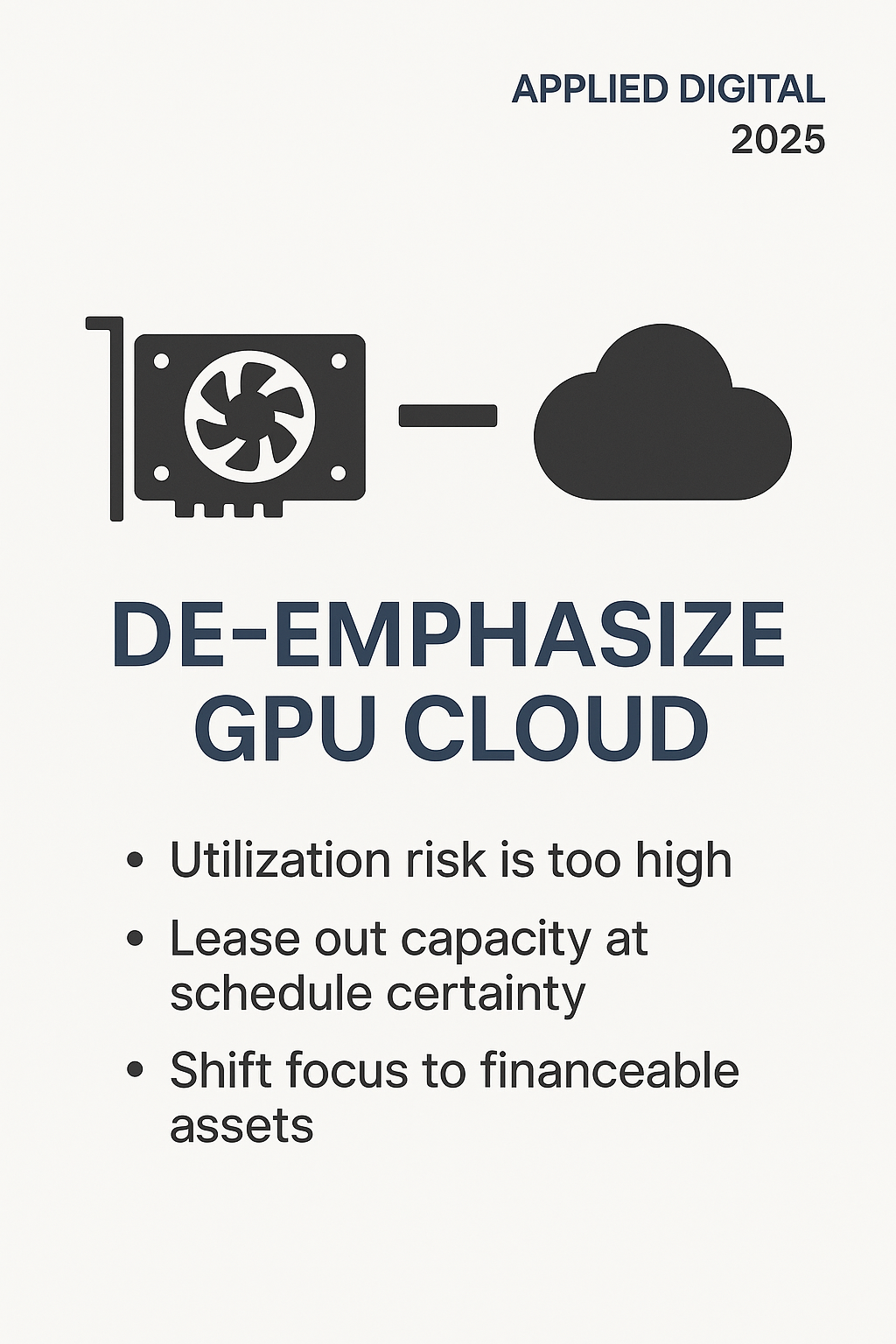
Why Applied had to de-emphasize GPU cloud: utilization is a bad denominator
Applied’s 2024 S‑3 describes its Cloud Services business (Sai Computing) as providing GPU computing solutions and rolling out clusters “each comprising 1,024 GPUs.” (ir.applieddigital.com) That posture puts you in a utilization business:
- You carry hardware risk and refresh cycles.
- You eat demand volatility (and price compression) directly.
- You must solve sales, onboarding, reliability, multi-tenant isolation, and customer concentration simultaneously. By October 2025, Applied disclosed it was “reviewing strategic options” for Cloud Services at the Board’s direction. (d1io3yog0oux5.cloudfront.net) This is consistent with a pivot to the landlord model: when the industry’s primary scarcity is “energized MW delivered on schedule,” GPU cloud is a distraction because it reintroduces utilization and hardware obsolescence as the core economic drivers. In AI infra, utilization risk is toxic capital.
The balance-sheet signature of the pivot: capital intensity becomes the point
Applied’s January 8, 2026 10‑Q (quarter ended November 30, 2025) shows a balance sheet that looks like a company trying to own the shell, not the chips:
- Property and equipment, net: $2,001,450 (in thousands). (ir.applieddigital.com)
- Long-term debt: $2,594,011 (in thousands). (ir.applieddigital.com)
- Cash and cash equivalents: $1,913,436 (in thousands). (ir.applieddigital.com) Those numbers are not “proof the model works,” but they are proof of commitment: the company is moving onto the playing field where construction financing, leases, and delivery execution dominate. The maneuver is to become a capital stack orchestrator where:
- The tenant provides revenue credibility (and sometimes fit-out cashflows).
- The landlord provides delivery capability.
- The financing market provides scale—if contracts look like institutional-grade leases. Your business model is your capital stack.
What’s unproven: can “AI factory landlord” become a durable moat?
This model is emergent because the moats are non-traditional. They’re not primarily software moats; they are repeatable, compounding operational competencies that lower the probability of missing a commissioning date. Moat candidates that actually matter in this specific architecture:
- Interconnection of design + procurement + commissioning: the “last mile” is transformers, switchgear, coolant loops, controls, and acceptance testing, not GPUs.
- Contract templates that lenders accept repeatedly: the lease has to be legible and enforceable across deals, with escalation, handover conditions, remedies, and extension options that don’t spook financing.
- A credible playbook for tenant-driven customization: fit‑out pushed tenant-side reduces landlord risk, but increases integration complexity; the landlord must standardize interfaces (power densities, cooling envelopes, delivery checklists). Applied’s disclosed “closed-loop, direct-to-chip liquid cooling” with a design PUE of 1.18 and near-zero water consumption is an attempt to productize that interface layer. (d1io3yog0oux5.cloudfront.net) The unresolved question is whether those interface standards can be stable while GPU generations and rack power profiles keep changing. The moat is the interface, not the building.
Cross-industry extrapolation with 1:1 mechanics: “take‑or‑pay capacity + customer-funded integration”
A precise parallel exists in midstream energy infrastructure (pipelines / LNG liquefaction / terminals), not because “both are infrastructure,” but because the contracts and risk allocation match:
- Long-term, capacity-reservation style commitments (take-or-pay equivalents) underwrite financing.
- Customer-funded or customer-specific integration (metering stations, laterals, compression; here: tenant fit‑out and compute-room specifics) is treated as a separate scope with separate economics.
- The operator’s durability comes from repeatable permitting + build + commissioning, plus bankable contract forms. Applied’s maneuver is essentially importing that midstream contract logic into AI data centers: leases (capacity reservation), fit‑out (customer integration), warrants (risk pricing without breaking contract bankability). When lenders understand the contract, you can scale.
Strategic synthesis: the real product is “MW-as-a-liability primitive”
The frontier shift is that “AI factories” are being defined less by hardware and more by the liability structure of capacity delivery. Applied’s maneuver is to make MW capacity a primitive that can be:
- Pre-sold in bankable form.
- Delivered with standardized technical interfaces.
- Financed at scale because the revenue looks like long-term contracted infrastructure rather than volatile compute utilization. If the model works, the winning operator is not the one with the most GPUs. It’s the one that can most reliably convert hyperscaler urgency into a contract that makes lenders comfortable writing large checks—without the operator secretly holding all the downside. The winner is whoever converts urgency into covenants.