Applied Digital’s “utilization ladder”: turning GPU time into contract-duration tranches (Reserved, Burst, Marketplace) to underwrite power-backed AI capacity
Applied Digital is not trying to “win cloud.” It is trying to **manufacture a sellable shape of utilization**—and then sell each slice at the contract...
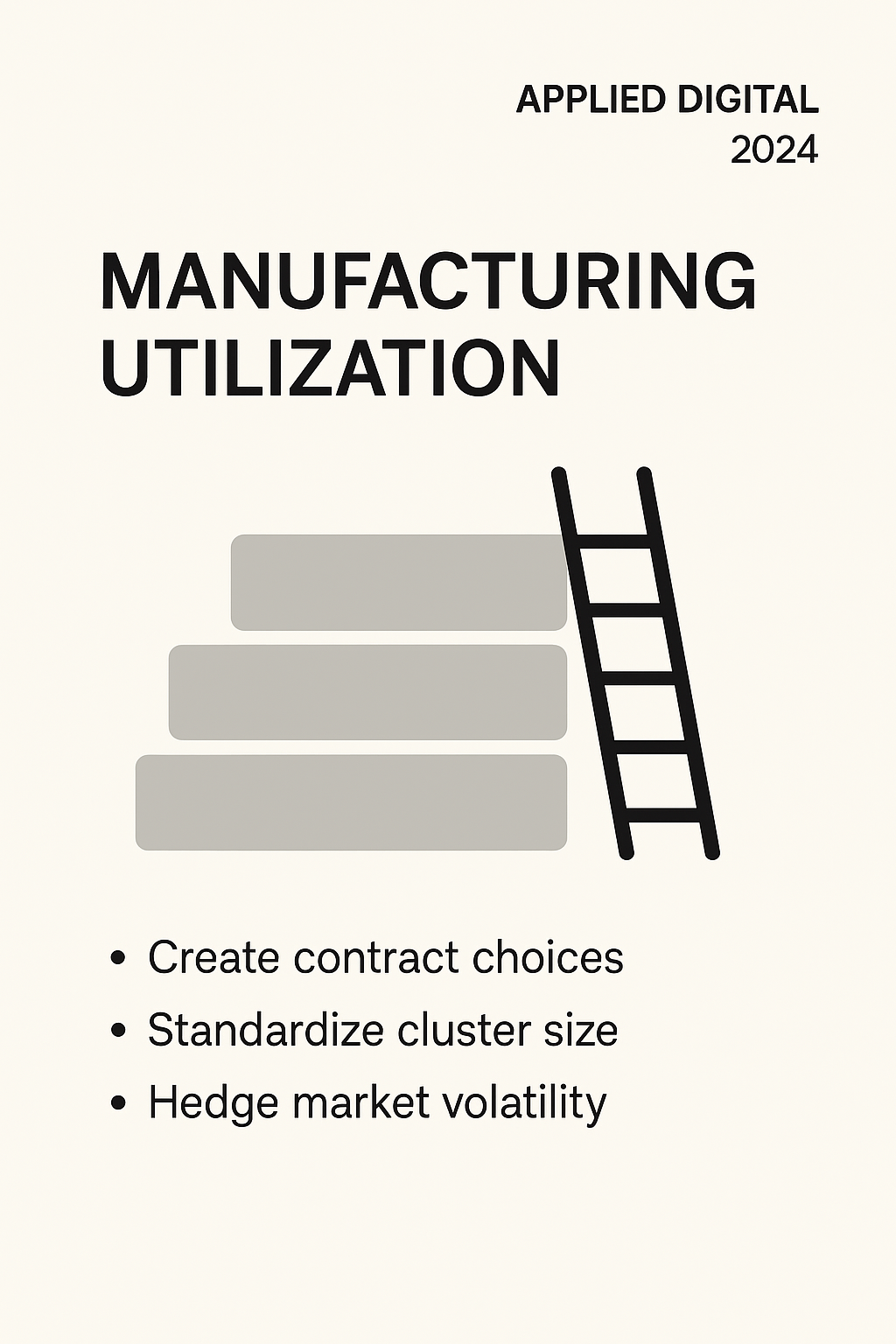
Applied Digital is not trying to “win cloud.” It is trying to manufacture a sellable shape of utilization—and then sell each slice at the contract length that can actually clear the buyer’s internal approvals. The maneuver (executed and formalized in filings and investor materials across 2024) is a three-tier commercialization stack for the same underlying asset: GPU clusters and the power + facility envelope around them. (ir.applieddigital.com)
The product is not GPUs; it’s duration-priced certainty
A GPU fleet is economically weird: it is a fast-depreciating compute asset embedded inside slow-depreciating infrastructure (building, power delivery, cooling). That mismatch creates an unsolved constraint: someone has to eat the “duration gap” between what infrastructure financiers want (years of contracted cash flows) and what many AI teams can credibly commit to (weeks to quarters). Applied Digital’s offering design is a direct attempt to trade that constraint, not eliminate it. The company explicitly describes three commercial forms:
- Reserved Compute: a standard cluster size (1,024 GPUs) with a 6‑month minimum term and contracts extending up to 72 months, at fixed price. (ir.applieddigital.com)
- Burst Compute: short-term reserved access priced variably “based on availability.” (ir.applieddigital.com)
- Short Term Marketplace: granular pricing per GPU-hour / server-hour. (ir.applieddigital.com) This is not “three SKUs.” It’s a duration ladder whose purpose is to let Applied Digital place the same capacity into three different budgeting regimes on the customer side, while preserving an internal path to higher certainty. Strategic rule: price volatility is a feature, not a bug. The marketplace tier is not only a revenue line; it is a pressure valve that prevents the whole fleet from being hostage to a few long commitments struck at the wrong moment in the GPU cycle.
The 1,024‑GPU cluster is a financing primitive
Applied Digital states it is “rolling out numerous GPU clusters, each comprising 1,024 GPUs, which are available for lease.” (ir.applieddigital.com) That cluster size matters strategically because it standardizes three things at once:
- A quotable unit for Reserved Compute (something procurement can approve without renegotiating architecture each time). (ir.applieddigital.com)
- A capacity planning unit for colocation and owned-site buildout (power and space blocks map to repeatable deployments). (ir.applieddigital.com)
- A risk container: if GPU obsolescence accelerates, the company can retire/refresh in standardized increments rather than unraveling bespoke customer builds. This is the deeper move: “cluster-as-a-lease-module” lets Applied Digital act like an infrastructure originator. It can originate capacity modules and then allocate them across a portfolio of contract durations. Pithy rail: standardization turns capex into inventory. Not retail inventory—financing inventory: discrete modules you can commit, refinance, or redeploy.
Selling “variability management” to itself (and to capital markets)
The company’s 10‑K is unusually candid about what it is trying to buy with contract structure: it says it is attempting “to reduce the impact of variability on our revenue and hosting costs by entering into long term contracts.” (ir.applieddigital.com) Then it draws a bright line between two businesses with two different duration targets:
- Cloud hosting GPU cluster contracts spanning 24–36 months. (ir.applieddigital.com)
- HPC Hosting business intending to sign ~10‑year hosting contracts. (ir.applieddigital.com) This matters because it reveals the internal economic architecture: the “cloud services” tier is the shorter-duration cashflow engine meant to ramp utilization, while the long-duration HPC hosting posture is the eventual bond-like product. In the same section, Applied Digital flags the central unresolved risk: these are “novel products” and “the value and longevity of the GPUs remain uncertain in this rapidly evolving market.” (ir.applieddigital.com) So the three-tier ladder is also a risk-hedging system:
- If GPU generations turn over faster than expected, the company wants enough short-duration paper (Burst + Marketplace) to reprice quickly.
- If demand spikes and customers need assurance, it can convert that demand into longer-duration fixed-price Reserved Compute.
- If financiers demand longer certainty, it can point to the pathway from volatile utilization (marketplace) → repeat buyers → reserved terms → site anchor tenancy. Pithy rail: the real customer is your balance sheet. The offering exists to create financeable predictability without requiring customers to pretend they know the future.
Why this is emergent (and unproven): “capacity underwriting” collides with model volatility
In classic cloud, the provider diversifies across millions of workloads and hides utilization math behind abstraction. Applied Digital is doing something closer to explicit underwriting: it’s packaging utilization into instruments. But AI workloads have a unique instability: model choices, serving stacks, and batch-vs-real-time mixes can swing GPU needs abruptly. Applied Digital’s own filings emphasize uncertainty around GPU longevity/value, which is a proxy for this deeper volatility. (ir.applieddigital.com) That creates a second-order constraint: even if you sell a 24–36 month lease, the buyer might churn not because they dislike you, but because their architecture changes (model distillation, quantization, different accelerators, or a shift to alternative compute). So the emergent bet is: can a provider out-operate that volatility with commercial structure? Mechanically, the ladder only works if Applied Digital can repeatedly execute three conversions:
- Marketplace/Burst users become Reserved Compute buyers (trust + performance + support). (ir.applieddigital.com)
- Reserved Compute becomes anchor tenancy for owned sites (duration extension). (ir.applieddigital.com)
- Owned sites + anchor tenants reduce unit costs enough to keep marketplace pricing competitive without commoditizing the whole business. None of those conversions are guaranteed; they are operationally heavy and require sophisticated fleet scheduling, customer success for infra, and disciplined capacity release policies. Pithy rail: the conversion funnel is operational, not marketing. Your “growth” is won in dispatch, SLAs, and upgrade paths—not in lead gen.
The precise cross-industry parallel: airline seat inventory control (not “cloud”)
The closest 1:1 mapping is to airlines, specifically seat inventory control and fare classes—not because “pricing is dynamic,” but because the underlying economics match:
- A perishable inventory unit (a seat on a specific flight at a specific time) maps to a GPU-hour on a specific cluster/time window.
- The operator runs a capacity release function: how many seats to sell in each fare bucket vs hold for late-booking high-yield customers maps to how many GPUs to commit to long fixed-price Reserved Compute vs keep for Burst/Marketplace repricing. (ir.applieddigital.com)
- The operator uses fare fences (refundability, advance purchase, Saturday stay) to segment willingness-to-pay; Applied Digital’s fences are contract term, cluster size standardization, and availability-based pricing. (ir.applieddigital.com)
- Both face the same core failure mode: over-allocating to low-yield long commitments suppresses upside in peak demand; over-reserving for spot buyers drives utilization collapse. That is a true structural parallel: the business is not “selling compute,” it is executing yield management on a constrained, time-indexed resource. Pithy rail: you’re building revenue management, not a datacenter. The datacenter is the factory; the product is the allocation algorithm plus contract design.
Strategic synthesis: the “utilization ladder” is a new kind of go-to-market
Applied Digital’s maneuver is a bet that the next compute intermediaries will compete less on raw silicon access and more on their ability to translate volatile AI demand into cash flows that capital markets can underwrite. The three tiers (Reserved, Burst, Marketplace) are best read as a single integrated system:
- Marketplace and Burst are the discovery layer for demand shape and willingness-to-pay. (ir.applieddigital.com)
- Reserved Compute is the packaging layer that turns discovered demand into duration. (ir.applieddigital.com)
- Longer-term hosting ambitions (explicitly discussed as ~10-year in HPC Hosting) are the endgame: convert utilization competence into infrastructure-scale certainty. (ir.applieddigital.com) If this works, the durable advantage is not “GPUs” (which are copyable) but a repeatable underwriting + yield-management capability that can survive hardware cycles. If it fails, it will fail in one of two crisp ways:
- The ladder cannot produce enough duration to finance owned sites at acceptable terms.
- Or it produces duration at the wrong price point, and the company gets trapped in below-market long commitments while the marketplace resets. That is exactly why the model is frontier: it is not an app. It is a live experiment in turning AI compute volatility into structured revenue without a hyperscaler balance sheet.