Cerebras’ pay‑per‑token maneuver: selling *throughput as the scarce good* (not “a model”) on wafer‑scale inference
Cerebras’ last-18-month maneuver is not “another inference API.” It is a market redesign: take wafer-scale inference—where the technical advantage exp...
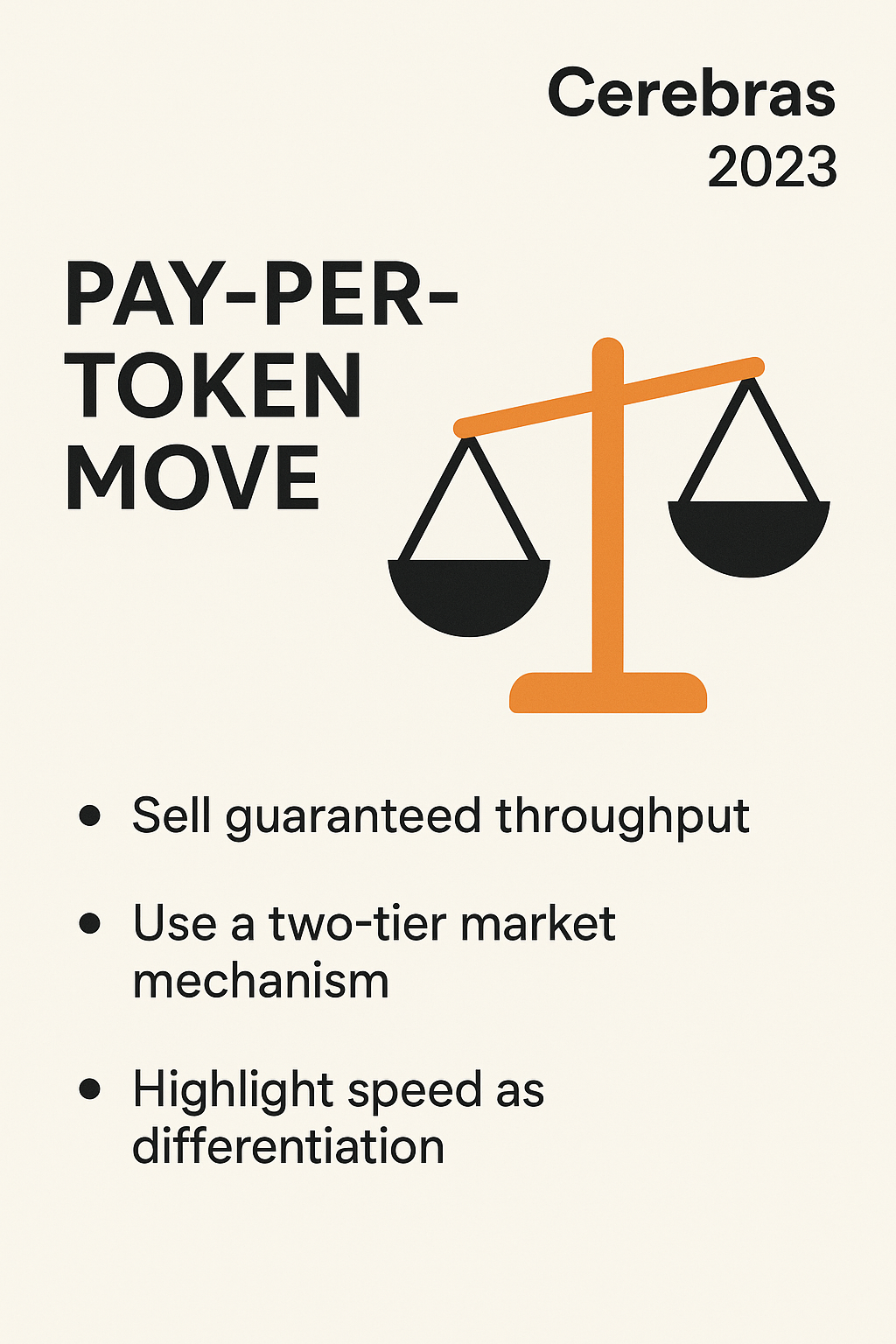
Cerebras’ last-18-month maneuver is not “another inference API.” It is a market redesign: take wafer-scale inference—where the technical advantage expresses as extreme tokens/second—and commercialize it with a retail meter (pay per token) while keeping an enterprise contract primitive that is explicitly about reserved token processing capacity. If you can’t sell utilization, sell guaranteed throughput. (cerebras.ai)
The underlying constraint: inference is cheap per token, expensive per peak
In LLM inference, the hard economic problem is not average cost. It’s peakiness: customers want “instant” responses at unpredictable times, which forces providers to hold capacity that sits idle. Cerebras’ wafer-scale angle makes this sharper: its core differentiation is latency/throughput, which is only valuable when you can access it on demand. So the unsolved constraint becomes: how do you monetize a fleet where the product is “time-to-first-token + tokens/sec,” but the billable unit the ecosystem understands is “tokens”? Token meters ignore peaks; businesses die on peaks.
What changed with pay‑per‑token: Cerebras moved from “projects” to “a market”
Cerebras publicly flips Cerebras Inference into a self-serve pay-per-token offering (credit card, low-friction entry), explicitly framing it as broadly available infrastructure rather than bespoke deployments. (cerebras.ai) Separately, Cerebras’ own technical deck shows the intended operating pattern: a free tier with request-rate and daily-token limits, and a paid tier with token pricing. (hc2024.hotchips.org) That combination is the maneuver. Not “usage-based pricing” in the abstract, but a two-tier market mechanism:
- Free tier is not generosity; it is a controlled load generator.
- It creates predictable background traffic while hard-capping the worst-case abuse via request/minute and daily token limits. (hc2024.hotchips.org)
- Retail paid tier (pay-per-token) is a liquidity instrument.
- It creates a long tail of workloads that can be scheduled and multiplexed.
- High-throughput plans / enterprise motion can now be positioned as buying a different good: priority + higher limits + less variance, rather than “the same thing but with an invoice.” (cerebras.ai) Self-serve is a scheduler disguised as a pricing page. (cerebras.ai)
The critical nuance: the “unit” is tokens, but the product is speed
Cerebras markets speed records (e.g., 2,000 tokens/second on K2 Think) as a defining feature of the service. (cerebras.ai) It also publishes model-specific throughput and per-token pricing (example: gpt-oss-120B at “3000 tokens per second” with explicit $/M input and $/M output pricing). (cerebras.ai) This is not cosmetic. It’s an attempt to turn “tokens/sec” into a buyer-visible dimension, even while billing remains token-based. Why that matters economically:
- Token billing aligns with developer procurement and comparisons.
- Speed differentiates what the buyer can build:
- real-time agent loops,
- tool-calling that must stay under human patience thresholds,
- multi-step reasoning chains where latency compounds.
- Speed also changes platform risk:
- if responses are near-instant, developers will call the model more often, producing burstier traffic.
- bursts are exactly what destroy utilization. So Cerebras is simultaneously amplifying the demand-shape problem (by making fast interaction feasible) and trying to contain it (via rate limits, tiering, and price discrimination). Faster models create more calls, not fewer. (cerebras.ai)
Why “pay per token” is strategically unproven here
The emergent business model bet is that a provider whose advantage is throughput can still thrive on a token meter. That is not guaranteed. Token pricing pays you for work done (tokens generated), but it doesn’t directly pay you for capacity reserved (the thing that makes speed possible at peak). This creates three structural hazards:
- Throughput externality: the very attribute that wins deals (speed) increases burstiness and concurrency demand, which raises the cost of delivering the same number of tokens.
- Adverse selection by workload shape:
- “spiky, interactive” customers disproportionately value speed and will concentrate on you,
- while “smooth batch” workloads may arbitrage toward cheapest-per-token providers.
- Benchmark gaming risk: if the market anchors on $/M tokens, competitors can cut price while quietly degrading latency, and buyers won’t notice until production. Cerebras’ answer appears to be: make speed salient, then sell differentiated access (higher limits, plans, enterprise arrangements) once customers hit real constraints. (cerebras.ai) A token price without a latency SLA is incomplete.
The hidden wedge: turning inference into a capacity portfolio
Cerebras also positions itself as building large-scale inference capacity (“over 40 million tokens per second by the end of 2025”). (cerebras.ai) Read that carefully: it’s a capacity statement in throughput units, not in “GPU count” or “requests/day.” That’s consistent with the business model direction: manage a portfolio of:
- elastic retail demand (token-metered),
- predictable baseline demand (free tier + subscriptions),
- reserved high-priority demand (enterprise / dedicated arrangements),
- and model-specific “featured launches” with explicit price/throughput claims. (cerebras.ai) If this works, the strategic outcome is not “Cerebras sells inference.” It’s “Cerebras becomes a throughput market-maker,” smoothing demand to keep a wafer-scale fleet highly utilized while preserving a premium lane for the workloads that truly need deterministic speed. The product is not tokens; it’s queue position.
What you can port to other industries (only where the mechanics match 1:1)
This maneuver maps precisely to any business where:
- capacity is purchased in large indivisible chunks,
- demand is spiky and latency-sensitive,
- retail metering is in a unit that fails to price peakiness,
- the winning move is to introduce a two-part market: cheap elastic access plus paid priority. Two direct matches:
- Interconnection bandwidth / transit markets (not generic “networking”):
- Mbps billed can mask congestion externalities,
- the real product is priority and predictable delivery at peak,
- successful operators separate best-effort from reserved capacity.
- Power markets with demand charges (not generic “utilities”):
- kWh is the token; peak kW is the throughput,
- customers can be cheap on energy yet expensive on peaks,
- tariffs evolve to explicitly price capacity reservation. In both, the business is a portfolio optimization problem with a retail meter that must be “good enough” to create liquidity, plus contract constructs that directly monetize peak. Whenever peaks dominate cost, sell priority explicitly.
Strategic synthesis: the “token economy” needs a second meter
Cerebras’ maneuver is a credible attempt to fix the misalignment between what users buy (fast, interactive intelligence) and what they’re billed for (tokens). The play will succeed only if Cerebras can make a second meter legible—rate limits, higher TPM, reserved capacity, or some SLA-like construct—without breaking the developer simplicity that pay-per-token unlocked. If pay-per-token remains the only story, Cerebras risks becoming the “fastest commodity token printer,” attracting the very workloads that make utilization hardest. If Cerebras succeeds, it establishes a frontier template: retail tokens for adoption, but throughput reservation as the true monetization surface for agentic, real-time systems.