CoreWeave’s new business model: selling *future GPU utilization* as a bankable contract, not a cloud SKU
CoreWeave’s maneuver (2025–2026) is not “GPU cloud, but faster.” It is the deliberate conversion of an operationally fragile asset—rapidly depreciatin...
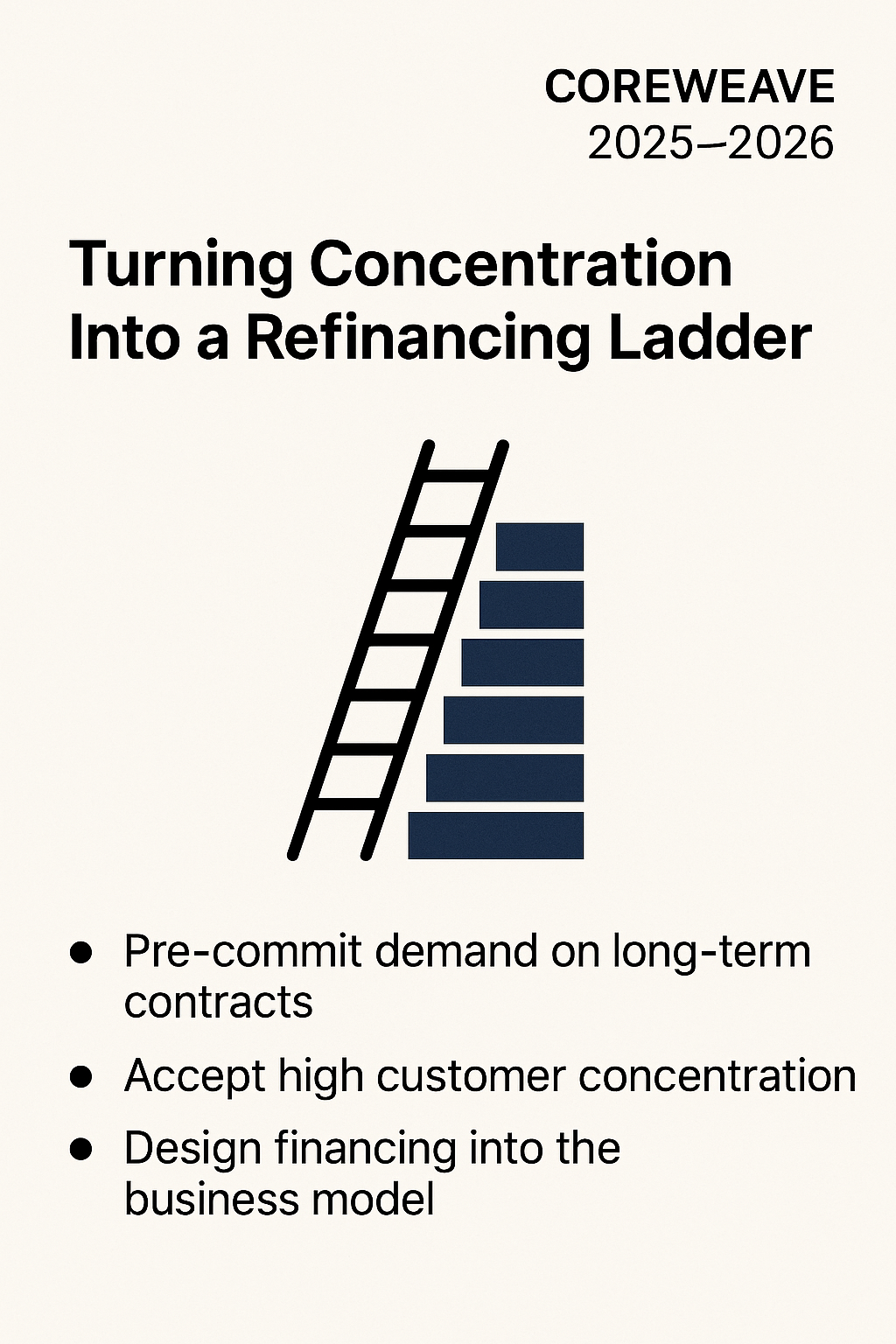
CoreWeave’s maneuver (2025–2026) is not “GPU cloud, but faster.” It is the deliberate conversion of an operationally fragile asset—rapidly depreciating GPU clusters—into a financeable product whose real unit of sale is multi-year committed capacity. The non-obvious move is that CoreWeave is shaping itself less like a traditional on-demand cloud and more like a contracted infrastructure counterparty, using long-duration order forms to turn utilization risk into a balance-sheet instrument. (s205.q4cdn.com)
When the scarce resource is time-on-cluster, the product becomes a contract
The central constraint in LLM infrastructure economics is not “compute is expensive.” It’s that the buyer’s demand profile is lumpy (training runs, launches, step-function scaling), while the seller’s cost profile is front-loaded (capex now, depreciation immediately, debt service monthly). If utilization is the risk, contracts are the technology. CoreWeave makes that constraint explicit by acknowledging that it expects customer concentration to persist “because of the long-term nature of contracts.” This is an inversion: concentration stops being a go-to-market weakness and becomes the underwriting substrate. (s205.q4cdn.com) Mechanically, the model leans on three coupled design choices:
- Pre-commit demand at hyperscaler scale. OpenAI commits up to approximately $6.5B through May 31, 2031 via an order form under a master services agreement; Meta commits up to approximately $14.2B through December 2031 via an order form under an existing master services agreement. (s205.q4cdn.com)
- Accept extreme customer concentration as an early equilibrium. CoreWeave recognized approximately 67% of 2025 revenue from Microsoft, and explicitly warns that top customers may build their own infrastructure or shift to competitors. (s205.q4cdn.com)
- Use financing as a first-class product layer, not a corporate afterthought. The company’s cash flow profile shows the intended shape: ~$10.3B net cash used in investing activities in 2025 alongside ~$9.3B provided by financing activities (driven by debt issuance and IPO proceeds). (s205.q4cdn.com) This creates a tight coupling between “capacity sold” and “capacity financed.” The contract is doing double duty: it’s revenue logic and capital market collateral in spirit (even when not formally pledged).
The real innovation: turning concentration into a refinancing ladder
If CoreWeave only had Microsoft-scale concentration, its strategic ceiling would be obvious: a single buyer can renegotiate you into a marginless captive supplier. Instead, CoreWeave’s maneuver is to replace single-anchor concentration with multi-anchor concentration—still concentrated, but now legible as a portfolio of long-dated counterparties that can support refinancing cycles. The goal isn’t diversification; it’s refinanceability. The 10-K is unusually direct that OpenAI and Meta are expected to be “significant” customers in future periods due to these long-term commitments. That matters because it changes the conversation with capital providers from “bet on spot GPU pricing” to “underwrite contracted cashflows from named counterparties.” (s205.q4cdn.com) You can see the refinancing ladder being assembled in public disclosures:
- CoreWeave completed an upsized $2.25B convertible senior notes offering, with an explicit dilution-management structure (capped calls) and detailed redemption mechanics. This is classic late-stage infrastructure behavior: push maturity outward, keep equity optionality, and retain flexibility on conversion settlement (cash/shares/mix). (investors.coreweave.com)
- The capital stack is being engineered for repeated market access, not for “one-time growth funding.” Convertibles (plus capped calls) are a way to fund expansion while preserving the narrative of operating leverage—even when the underlying economics are still dominated by depreciation and interest. This model works only if the company keeps one variable under control: utilization volatility. The order-form commitments are the shock absorbers.
Why “GPU cloud” pricing is not the product—dispatch control is
The naive reading is that CoreWeave sells compute and tries to maximize margin per GPU-hour. The strategic reading is that CoreWeave is buying itself the right to run a tightly coupled dispatch machine across a dedicated fleet: scheduling, topology-aware placement, and customer-specific performance tuning that hyperscalers struggle to justify for any one tenant. In dedicated AI infrastructure, scheduling is the margin. The financing and contracting strategy is what makes dispatch control economically exploitable:
- Without commitments, the seller must optimize for spot monetization and keep assets liquid across many small customers.
- With commitments, the seller can optimize for throughput certainty and engineer around a smaller number of large workloads (better packing, more predictable maintenance windows, more aggressive standardization). This is why “customer concentration” is simultaneously the largest stated risk and the core enabling condition of the model. CoreWeave is essentially admitting that its architecture is built to be a high-performance supplier to a few very large buyers, and that it may not translate cleanly to a long tail. (s205.q4cdn.com)
The unsolved constraint: counterparty-driven commoditization of your own core capability
The 10-K’s risk language points to the structural trap: top customers “may develop their own infrastructure” or “adopt a competitor’s infrastructure” for services they currently buy. (s205.q4cdn.com) That is not a generic “competition risk.” It is a precise economic threat:
- The more CoreWeave helps a customer scale, the more it teaches them the operational envelope (power, networking, failure modes, software stack expectations).
- The more standardized GPU infrastructure becomes (rack-scale systems, reference designs, broadly understood networking patterns), the more the buyer can threaten credible self-supply.
- Once the buyer can self-supply, the supplier’s contract renewal becomes a refinancing event—because the supplier’s debt was built against the assumption of renewal or replacement contracts. CoreWeave’s hedge is not “be cheaper.” It is “be the fastest path to capacity at scale,” and then use long-dated commitments to survive long enough to refinance the fleet repeatedly.
Cross-industry extrapolation (1:1 economic architecture): LNG liquefaction projects, not “cloud” analogies
The closest structural parallel is LNG liquefaction / regasification infrastructure, where:
- The developer raises massive upfront capital.
- Revenue is stabilized via long-term take-or-pay contracts with a small number of large offtakers.
- The asset’s value is dominated by utilization and counterparty credit, not by marginal operating cost. If your asset is irreversible capex, you sell take-or-pay. Map it directly:
- GPU fleet capex ↔ liquefaction train capex.
- Multi-year capacity commitments (OpenAI/Meta order forms) ↔ long-term offtake agreements.
- Refinancing ladder (convertibles + ongoing debt issuance) ↔ project refinancing once contracted cashflows are visible.
- Core risk: offtaker backward integration (build their own terminals / supply chain) ↔ model labs/hyperscalers building their own data centers. This is not metaphor. It is the same underwriting logic: banks and public markets fund the asset because the contract makes utilization predictable enough to carry leverage.
Strategic synthesis: what CoreWeave is really building, and what breaks it
CoreWeave is building a “contracted compute utility” inside a market that still pretends it is buying elastic cloud. The maneuver is to force the market to accept contracts as the native interface for frontier-scale AI capacity. Two conditions must hold for the model to compound:
- The company must keep signing long-dated commitments faster than its fleet depreciates and faster than customers backward-integrate.
- The company must preserve dispatch/performance differentiation enough that counterparties view self-supply as slower or riskier than renewal—even if self-supply is cheaper. Three things break it, mechanically:
- A step-change in buyer self-supply that collapses renewal probabilities (contract rollover cliff).
- A technology transition that strands a fleet before it amortizes (hardware cycle outruns contract duration).
- Capital markets refusing to refinance “GPU utilities” on attractive terms once growth normalizes (the leverage story stops working without a growth multiple). In GPU infrastructure, your moat is renewal probability. CoreWeave’s maneuver is sophisticated precisely because it accepts that the core product is not compute; it is a credible promise of delivered capacity over time—one that can be financed, refinanced, and re-contracted before the physics of depreciation wins.