Crusoe’s “energy-first” pivot: turning flare-gas compute into an AI datacenter financing instrument
Crusoe’s maneuver wasn’t “pivot from crypto to AI” in the superficial sense. It was a deliberate divestiture of the *business model that made its powe...
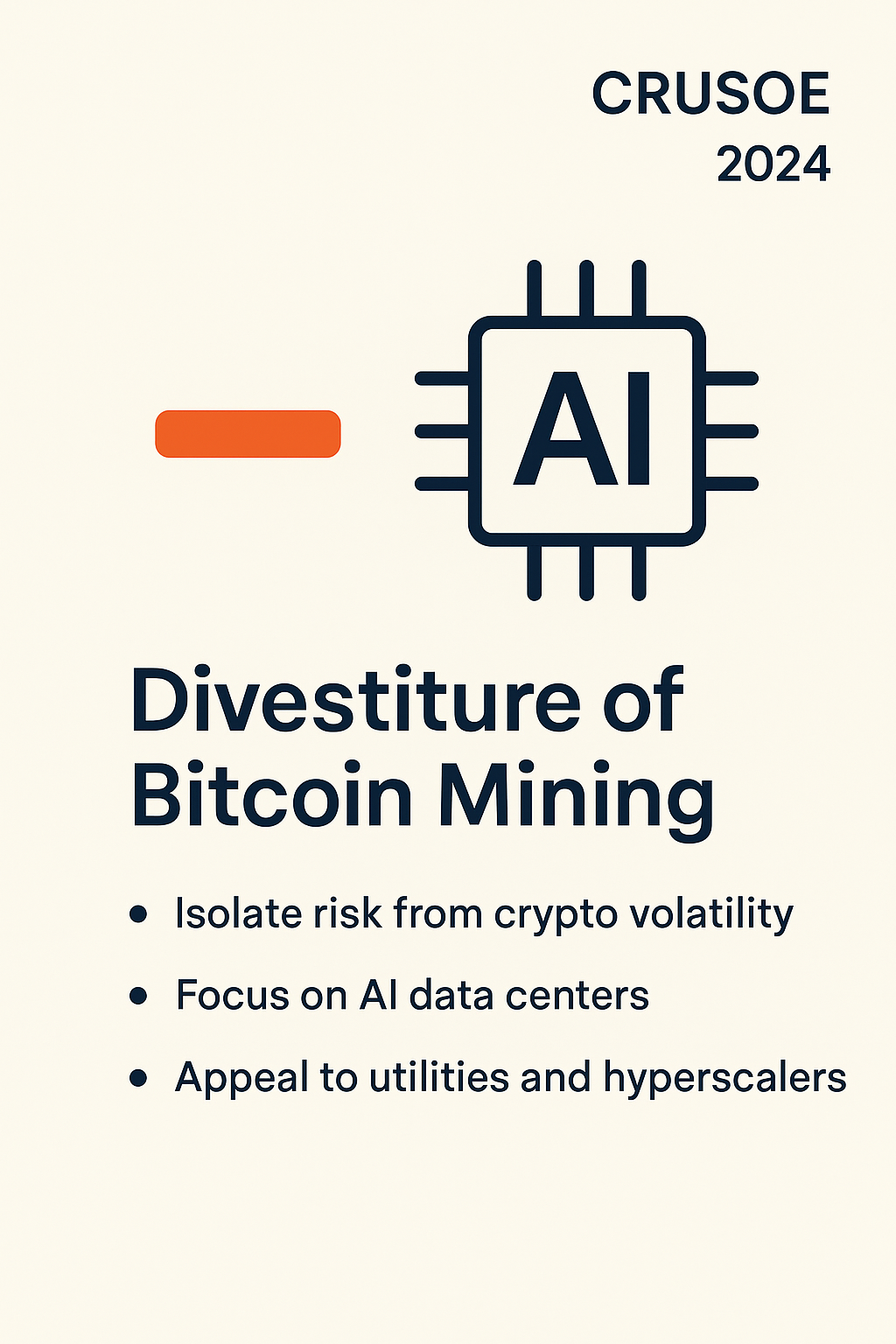
Crusoe’s maneuver wasn’t “pivot from crypto to AI” in the superficial sense. It was a deliberate divestiture of the business model that made its power strategy legible, so the company could recompose around hyperscale AI data centers and inference as the dominant monetization path. (nydig.com)
The hidden constraint: AI datacenters don’t fail on GPUs—they fail on bankable power
GPU supply is the headline bottleneck, but Crusoe is reacting to a deeper economic constraint: AI training/inference projects die when power, interconnect, cooling, and schedule risk can’t be packaged into something financeable. If power can’t be underwritten, compute can’t exist. Crusoe built early competence where few AI infrastructure players had an edge: it treated energy as the product boundary, not a cost center, via Digital Flare Mitigation (DFM). (crusoe.ai) Then it made a sharp move: transfer the DFM + bitcoin mining operating machine to NYDIG (announced March 25, 2025), while explicitly “channeling the same energy-first mentality towards scaling AI infrastructure.” (nydig.com) This is not retreat. It’s organizational unbundling to make AI infrastructure legible to counterparties (utilities, lenders, hyperscalers) that dislike “hybrid” balance sheets and mixed operational narratives.
Divestiture as capital hygiene: removing the “wrong volatility” from the same electrons
The NYDIG announcement frames the acquired asset as “over 270MW of power generation technology” driving “near-zero direct cost of electricity,” and describes DFM converting flared gas into electricity for modular data centers. (nydig.com) That phrasing matters. It reclassifies what outsiders often see as a quirky bitcoin story into a power-and-compute industrial capability. Crusoe’s divestiture is best read as: “separate the part that prints money from weird power (PoW) from the part that needs predictable money to build power (AI).” AI datacenter scale punishes narrative ambiguity. Mechanically, the divestiture performs three strategic functions:
- Risk isolation: Bitcoin mining revenue volatility and regulatory perception risk stop contaminating the financing profile of an AI campus.
- Counterparty fit: Utilities, municipal authorities, and hyperscaler procurement teams are more likely to engage when the developer is not simultaneously an industrial-scale miner.
- Managerial focus on schedule: Hyperscale AI campuses are schedule businesses; missing delivery windows destroys the whole IRR. Crusoe’s 2024 Impact Report explicitly claims its vertical integration can “approximately” halve prior greenfield hyperscale construction timelines. (crusoe.ai)
DFM wasn’t “bitcoin mining”—it was a demand-response primitive wearing a mining mask
Here’s the non-obvious reframing: DFM’s core invention is not “use flare gas for compute.” It’s “attach flexible compute demand to stranded or constrained energy where the grid can’t absorb it,” and operationalize that reliably enough to sell at scale. In Crusoe’s 2024 Impact Report, Crusoe states that in 2024 its DFM converted over 10.4 billion cubic feet of flare gas into approximately 1.3 TWh of electricity, supplying 87% of its total electricity needs during the year. (crusoe.ai) Even if you ignore the climate framing, those figures imply something economically important: Crusoe learned to make compute follow energy, not the other way around. That capability is directly portable to AI—if you can finance it. Bitcoin mining is a convenient “always-on buyer” of power in messy places. AI is a higher-margin buyer—but only when you can guarantee uptime, cooling, networking, and delivery dates. So the move is essentially: keep the “energy-first” thesis, drop the “messy buyer,” upgrade to the “demanding buyer.” (nydig.com)
Abilene as the proof point: when the campus becomes the product
Crusoe’s 2024 Impact Report describes a 1.2 GW AI data center campus in Abilene, Texas, that broke ground in June 2024, chosen for proximity to wind energy, with direct-to-chip liquid cooling and a target PUE of 1.2–1.3, plus natural gas turbines for backup power. (crusoe.ai) This is a specific “campus-as-product” architecture:
- Energy sourcing strategy (wind proximity + backup generation choices)
- Cooling design (liquid cooling as a first-class constraint, not retrofit)
- PUE target (explicitly positioned as below typical “industry average,” per Crusoe) (crusoe.ai) The new monopoly isn’t GPUs—it’s time-to-power. By March 9, 2026, Oracle publicly stated (via an X post cited by Tom’s Hardware) that two buildings at the Abilene campus were operational and the remainder progressing; it also claimed leasing arrangements for an additional 4.5 GW of capacity to support commitments to OpenAI. (tomshardware.com) Whether those exact commitments evolve over time, the strategic pattern is stable: Crusoe is positioning itself inside the “AI megacampus” supply chain, where the scarce asset is deliverable power + buildings + thermal system + interconnect on a timeline.
The emergent business model: turning “power origination + construction velocity” into a balance-sheet advantage
What’s unproven—but strategically coherent—is the model Crusoe is implicitly assembling:
- DFM/bitcoin phase created a repeatable playbook for monetizing “difficult electrons” (stranded gas, constrained renewables, underutilized generation).
- The divestiture to NYDIG removes a line of business that is economically useful but capital-structure toxic for hyperscale AI.
- The AI phase converts the playbook into a campus delivery machine where the asset is not “compute instances,” but deliverable megawatts with a credible build system. If you’re a hyperscaler or frontier model lab, you don’t primarily buy GPUs. You buy a schedule that converts capex into tokens, fast. Crusoe is attempting to sell that schedule by making itself look like a “real infrastructure developer,” not an “energy/crypto startup.” (cnbc.com)
Why this is strategically different from “build a datacenter near cheap power”
Many datacenter developers can site near cheap power. Crusoe’s wedge is that it trained on non-standard power first, then moved to hyperscale. That sequence matters because the hard part of AI infrastructure is not merely “access to megawatts,” but operational control over the failure modes:
- fuel availability / curtailment dynamics
- black start and ride-through design choices
- cooling water constraints and permits
- construction supply chain constraints Crusoe’s Impact Report explicitly foregrounds closed-loop cooling (zero-water evaporation) and natural gas turbines as a backup choice—both are choices that reduce dependence on fragile local assumptions. (crusoe.ai) When power is the bottleneck, integration beats optimization.
Mechanically precise cross-industry parallels (1:1 mapping only)
Parallel A: LNG “tolling” / liquefaction capacity as the product (energy infrastructure). The 1:1 mapping is: in LNG tolling, the scarce asset is not the gas molecule; it’s permitted, financed, delivered processing capacity with a schedule and uptime profile. Crusoe is attempting the same abstraction for AI: not “GPUs,” but permitted and financed megawatt-to-compute conversion capacity. Parallel B: Merchant power plants contracting capacity, not electrons (power markets). In capacity markets, the product is availability under stress (a financeable reliability commitment), not raw kWh at any moment. Crusoe’s pivot separates the flexible-but-dirty-demand (bitcoin) from the reliability-priced demand (AI). The goal is to make “availability” underwritable for counterparties that require SLAs. These are not analogies about “lock-in” or “platforms.” They share the same financial architecture: monetizing bankable capacity commitments under uncertainty.
Strategic synthesis: Crusoe is trying to turn “stranded energy competence” into “AI schedule dominance”
The frontier constraint is not model quality; it’s that the world can’t stand up AI-grade power + cooling + buildings fast enough. Crusoe’s divestiture is a bet that hyperscale AI will reward the firm that can convert unconventional energy strategy into a conventional financing story—without losing the engineering edge that came from living in unconventional energy. Sell the campus, not the instance. The maneuver to watch going forward is whether Crusoe can standardize this into a repeatable “AI factory” deployment system that scales beyond one flagship site—because the business model only becomes defensible when the second and third campuses are faster, cheaper-to-finance, and less bespoke than the first.