Intercom’s $0.99 “Outcome” as a Financial Primitive: Turning LLM Inference Volatility into a Tradable Unit of Customer Support
Intercom’s maneuver is not “add AI to helpdesk pricing.” It is the creation of a new billable primitive—**the Outcome**—that deliberately refuses to t...
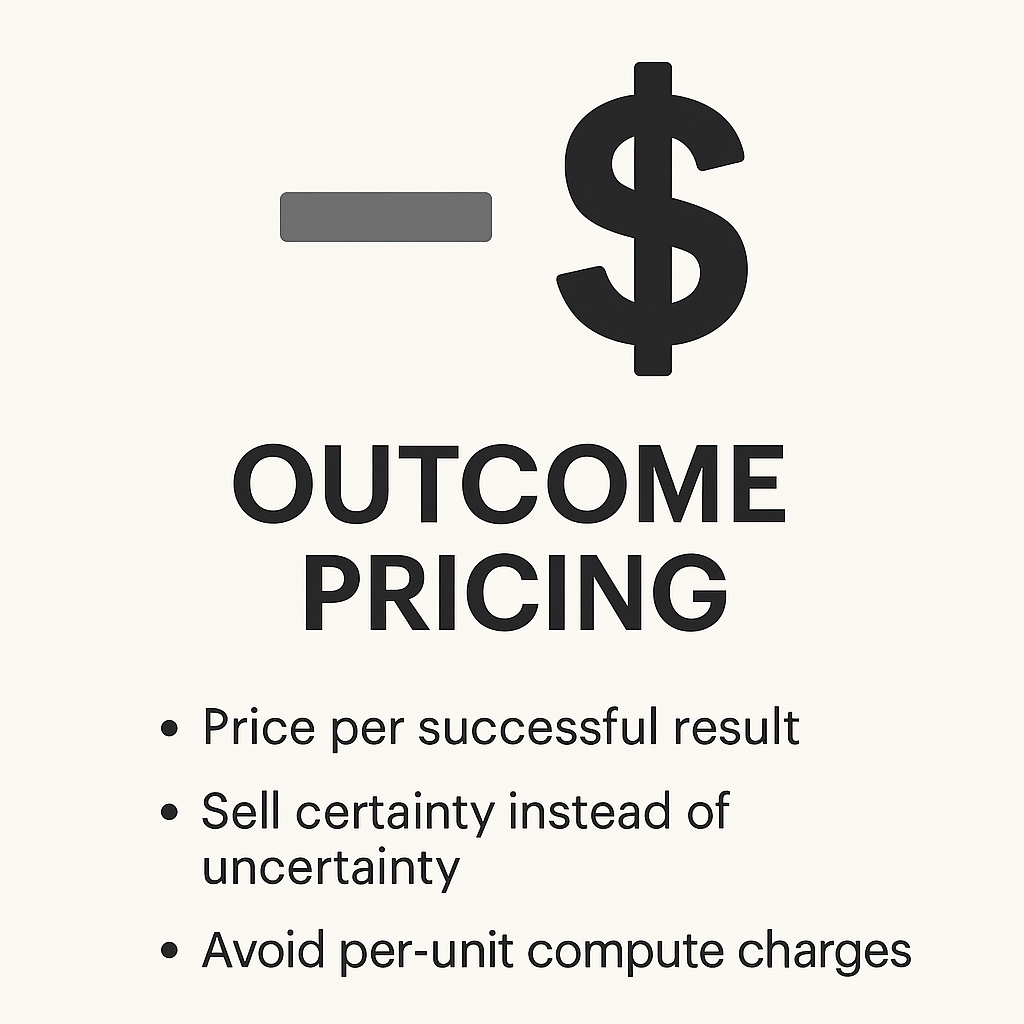
Intercom’s maneuver is not “add AI to helpdesk pricing.” It is the creation of a new billable primitive—the Outcome—that deliberately refuses to track the underlying compute meter. (intercom.com)
The real product is a contract, not a chatbot
Most AI agent businesses start with a technical artifact (a model + tools) and then struggle to price it. Intercom inverted that sequence: it defined the payable event first, and then engineered the system to make that event legible, auditable, and hard to game. Rule: Price what the buyer can verify, not what you run. (intercom.com)
“Outcome” is a deliberately non-computational unit
Intercom prices Fin AI Agent at $0.99 per outcome. (intercom.com) An outcome is counted when Fin successfully completes the action it was configured to perform, as part of a conversation, including a “Resolution” or executing a “Procedure” that ends in a resolution or an intentional handoff. (intercom.com) This definition matters because it’s not “per conversation,” “per token,” “per minute,” or “per seat.” It is a claims system, where Intercom is implicitly underwriting the cost of attempts that do not mature into payable events. Non-obvious synthesis: Outcome pricing is a risk swap on inference variance. (intercom.com)
The unsolved constraint: inference is stochastic, finance hates stochastic COGS
LLM cost isn’t merely “high.” It is unstable per unit of customer value because the path length to success varies: retrieval misses, customer ambiguity, escalation, retries, safety refusals, and tool-call cascades. If you price on compute, your customer buys “uncertainty.” If you price on outcomes, you sell “certainty,” and you retain the right to continuously re-optimize the uncertain layer (models, prompts, routing, caching, tool policies) without renegotiating the commercial contract.
Why this is an emergent model, not a mature one
Intercom’s Outcome creates a clean revenue unit, but it is still an unproven economic machine at scale because it pushes a hard systems problem onto Intercom:
- You must detect success robustly (did the customer actually get solved?). (intercom.com)
- You must prevent “success inflation” (nudging customers into premature confirmation).
- You must manage adversarial behavior (customers or agents manipulating the boundary between “resolved” and “needs human”). Intercom’s own policy choices reveal the hidden battleground: it specifies when a conversation is considered resolved even if a teammate later joins, and when it is explicitly not charged (customer asks for more help / a person). (intercom.com) Those aren’t UX footnotes; they are revenue recognition rules for agentic labor. Pithy rail: Billing edge-cases become your model’s product spec. (intercom.com)
Outcome pricing forces a new internal architecture: “attempt accounting”
Once you sell outcomes, you have to run the platform like an insurer with a real-time adjudication stack. Concretely, the agent needs an internal ledger that ties together:
- Conversation state transitions (open → answered → customer follow-up → handoff). (intercom.com)
- Tool execution logs for “Procedures,” including termination reasons (resolved vs intentional handoff). (intercom.com)
- A billing event generator that emits at most one charge per conversation (as stated on the pricing page). (intercom.com)
- A customer-facing audit surface (so finance teams can reconcile invoices to support transcripts). If you cannot build this accounting substrate, outcome pricing collapses into disputes and churn. So the real defensibility is not “model quality.” It is the ability to operationalize outcome adjudication with low friction. Strategic rule: Your agent’s “truth layer” is now the moat. (intercom.com)
The distribution move hidden inside the pricing move: cross-helpdesk deployability
Intercom explicitly markets Fin as usable with an existing helpdesk (e.g., “Fin on Zendesk or Salesforce”), still priced at $0.99 per outcome. (intercom.com) This matters because Outcome pricing is one of the few ways to sell into competitors’ installed bases without triggering immediate procurement rejection. Why?
- Seat-based pricing collides with the incumbent’s seats (double-paying for the same headcount).
- Token-based pricing forces the buyer to accept unpredictable pass-through costs.
- Outcome pricing cleanly composes: it behaves like a variable “labor line item” attached to the ticket stream, not a second platform tax. So the maneuver isn’t just “pricing innovation.” It’s a wedge that turns interoperability into a revenue channel.
The core economic mechanism: moving from “software margin” to “labor margin”
Outcome pricing quietly reclassifies the product in the buyer’s mind:
- Not “a feature we might use.”
- But “work we can offload, measured in completed units.” That changes who owns the budget. It pulls spend toward operations (cost per resolved issue) rather than IT (license governance), which is exactly where customer support decisions are made. Intercom then has a structurally different optimization objective than a typical SaaS vendor:
- Traditional SaaS wants high usage (more seats, more events).
- Outcome-priced agents want high success rate per attempt (because failed attempts are COGS with no revenue). This is a brutal discipline that tends to improve product quality faster than “pay-per-message” models, but it can also discourage the vendor from tackling hard edge cases (where success probability is low). Pithy rail: Outcome pricing rewards “boring reliability,” not clever demos. (intercom.com)
Where this breaks: when the customer’s definition of “done” is multi-step
Outcome pricing works best when:
- The completion criterion is binary and attributable (resolved / not resolved). (intercom.com)
- The conversation is the correct boundary for value (support interactions, not long-running projects). It breaks when value is path-dependent, multi-actor, or delayed:
- “Procure a refund” might require finance approval days later.
- “Fix my account” might involve engineering and a follow-up release. In those domains, the vendor will be pushed toward hybrid constructs: staged outcomes, escrowed outcomes, or SLA-backed outcome bundles. Intercom’s inclusion of “Procedures” as outcomes is an early signal that pure “resolution” is not enough for agentic workflows; the billing unit must expand to encompass tool-executed work that ends in an intentional handoff. (intercom.com)
Cross-industry extrapolation (mechanically 1:1): payment processing authorization vs settlement
A precise parallel exists in card payments, not in SaaS.
- In card payments, an authorization is an attempt; settlement is the payable event.
- Networks and acquirers invest heavily in fraud, retries, routing, and risk scoring because they monetize on successful settlements, not on attempted swipes. Intercom’s outcome pricing is the same architecture:
- Agent attempts (tokens, tool calls, retries) are analogous to authorizations.
- Billed outcomes are analogous to settlements.
- The vendor absorbs attempt variance and invests in routing/quality to increase “settlement rate.” The mapping is exact because both systems:
- Have high-volume, low-unit events.
- Need auditable logs to resolve disputes.
- Depend on classification at boundaries (approved/declined; resolved/unresolved). (intercom.com)
Strategic synthesis: what Intercom is really building
Intercom is building a market where “AI labor” is denominated in a unit buyers can procure and finance teams can reconcile. The agent is the engine, but the business model is a clearinghouse for completion claims. If Intercom (and competitors) make Outcomes standard, the next competitive frontier is not better prompts. It is better adjudication: outcome schemas, dispute resolution, auditability, and portable outcome definitions that survive across channels and helpdesks. Final rule: If you can standardize the payable event, you can own the market. (intercom.com)