One Truck, One Neighborhood
The most dangerous moment in a great company’s life is not failure. It’s tradition. When the world changes, you can’t negotiate with math. You can’t c...
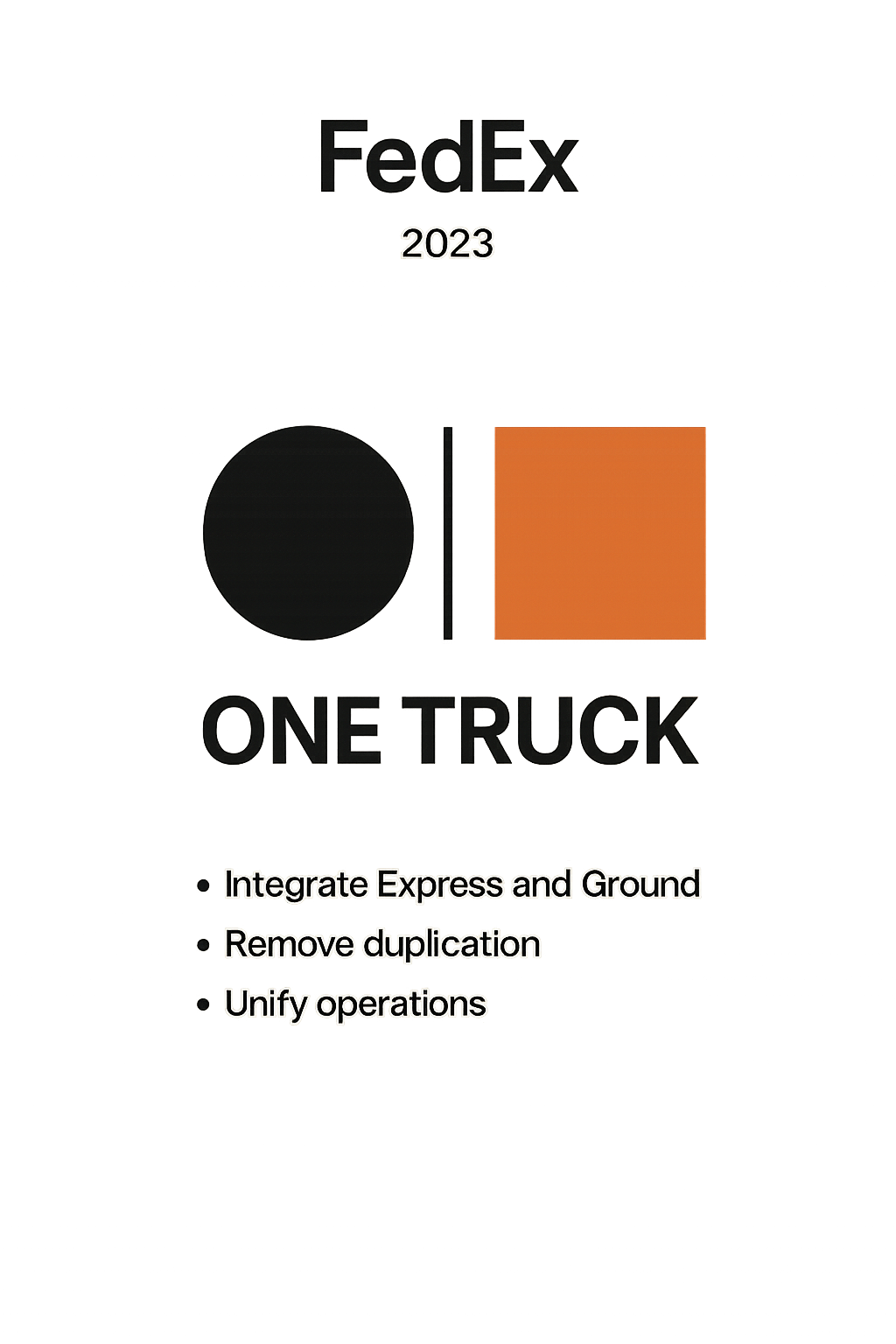
The most dangerous moment in a great company’s life is not failure. It’s tradition. When the world changes, you can’t negotiate with math. You can’t charm a cost structure. You can’t “brand” your way out of physics. FedEx faced a constraint that doesn’t care about pride: it had built a magnificent machine for a volume peak that did not last. Two networks ran through the same streets. Two trucks visited the same doors. Two systems duplicated the same labor. And demand stopped paying for the redundancy. That’s the trap. Not incompetence. Not lack of ambition. A design that made sense—until it didn’t.
A network is a promise.
But it is also a bill.
The constraint
FedEx is not a startup. It can’t “pivot.” It has planes in the sky, hubs on the ground, and people waiting at loading docks at 2 a.m. That’s why its constraint was existential: fixed commitments meeting variable reality. In early fiscal 2023, FedEx launched DRIVE, an enterprise transformation designed to enhance network efficiency, improve service, and cut costs—explicitly framing it as the most extensive undertaking in its history, with a target of $4 billion in permanent structural savings by fiscal 2025. (annualreports.com) Notice the language. Not “initiatives.” Not “optimization.” Transformation. Because the old shape couldn’t survive the new world. FedEx didn’t only admit the constraint. It wrote it into its legal risk disclosures: failure to execute DRIVE—including Network 2.0—could materially harm results. (sec.gov) That’s what constraints sound like when they become real. Not dramatic. Just plain. Just final.
The simplest diagnosis
For years, customers had accepted a strange ritual. A FedEx Express truck. A FedEx Ground truck. Same neighborhood. Same day. Different uniforms delivering different promises from the same brand. It worked when volume covered the inefficiency. It worked when growth forgave the waste. But the future doesn’t forgive. The future invoices you. And so FedEx articulated a truth so simple it feels obvious—until you try to implement it at national scale. At its 2026 Investor Day, FedEx described Network 2.0 like a designer describing a product: Customers don’t need both an Express and a Ground truck in the same neighborhood on the same day. They don’t need two separate pickups. They need simplified interactions and outstanding experiences. (s21.q4cdn.com) That sentence is more than operational logic. It’s philosophy.
Complexity is not sophistication.
Complexity is debt.
The bold move
FedEx didn’t chase a shiny new market. It didn’t declare a metaverse strategy. It didn’t rename itself a platform. It did something rarer. It chose integration over addition. Network 2.0 aimed to integrate the legacy Express and Ground operations into one unified surface network. (s21.q4cdn.com) And DRIVE became the discipline behind it: a system spanning domains and owners, built to convert intention into execution. FedEx projected DRIVE would deliver $4.0 billion of permanent cost reductions by fiscal 2025, with Network 2.0 driving an incremental $2 billion of savings in fiscal 2027 as the full benefits arrive. (newsroom.fedex.com) This wasn’t a slogan. It was a multi-year rewire of how packages move. Because the real strategy wasn’t “reduce costs.” The strategy was to remove duplication from the design. One network. One set of hands. One route plan. One stop density story. One truck. One neighborhood.
The sacrifice
Most companies talk about focus. Few pay for it. Focus is not the slide deck that says “priorities.” Focus is the meeting where you kill a beloved project. Focus is the facility you shut down. Focus is the route you redraw even though it breaks someone’s routine. At the 2026 Investor Day, FedEx said it had optimized over 360 stations while closing over 200, and that in completed markets it saw about a 10% reduction in pickup and delivery cost, with higher stop density and fewer duplicate routes. (s21.q4cdn.com) Read that again. Closed over 200. That’s not optimization theater. That’s a decision with names attached. And sacrifice didn’t stop at buildings. FedEx drove structural change into daily behavior. In its FY23 chairman’s letter, it highlighted a shift to a single daily dispatch of couriers—a gritty operational change that hit its $50 million quarterly savings target. (investors.fedex.com) No one puts “single daily dispatch” on a billboard. No customer tweets about it. That’s why it matters. It’s the kind of change you do when you’re serious. FedEx also committed to streamline its operating companies into one unified organization, with a phased approach planned for June 2024—choosing one structure over the comfort of many. (investors.fedex.com)
Strategy is not what you intend to do.
Strategy is what you are willing to stop doing.
The hidden battle: identity
The hard part of integrating networks isn’t the routing software. It’s the ego. Express is a culture. Ground is a culture. Freight is a culture. And cultures defend their borders. But the customer never bought your org chart. The customer bought a delivery. So FedEx did the adult thing: it put surface operations under unified leadership as part of the consolidation plan, while signaling that financial reporting would not immediately change during the transition period up to June 2024. (newsroom.fedex.com) That matters because it shows restraint. It’s not enough to say “we are one company.” You have to migrate carefully while the planes keep flying.
The execution principle
In transformation, there is a seductive lie: “If we build the perfect plan, the work will happen.” The work never happens because of the plan. It happens because of accountability. Named owners. Clear domains. Measurable outcomes. On a fiscal 2023 earnings call, FedEx leadership described how DRIVE assigned individuals to domains accountable for realizing identified opportunities, building a framework for measurement and ownership. (investors.fedex.com) That’s not glamorous. It’s the scaffolding. And scaffolding is what holds the building up while you rebuild the building.
What this really was: a redesign
Network 2.0 wasn’t a “program.” It was a redesign of the product. And the product was the network. You can feel it in the way the operator described implementation: One station. One route. One neighborhood at a time. (s21.q4cdn.com) Designers know this. You don’t redesign a complex system with a press release. You do it with iteration. You do it with proof-of-concepts. You do it with humility in the face of edge cases. And FedEx admitted the most important design truth of all: One size does not fit all markets. (s21.q4cdn.com) A network is local. Weather is local. Traffic is local. People are local. So the redesign had to be both unified and adaptive. That is the paradox of great systems: Central intent. Local intelligence.
The clarity that cuts through the noise
A lot of strategy writing hides behind abstraction. “Synergies.” “Transformation roadmap.” “Operational excellence.” FedEx gave us a sentence you can draw on a napkin: Customers don’t need two trucks. (s21.q4cdn.com) That’s what timeless strategy sounds like. Not complicated. Not trendy. Just true. And the savings targets are not the story. The story is the discipline to accept that your proudest architecture may have become a luxury you can no longer afford.
The lesson, stripped down
If you lead anything—company, team, product, life—this is the pattern:
- The world shifts.
- Your old design becomes expensive.
- You can deny it, or redesign. Redesign requires a kind of courage that looks boring from the outside. Close the station. Retire the asset. Change the dispatch. Unify the route. Hold the line. Repeat. And while you do it, keep the promise. Because in logistics, service is the only marketing that matters. FedEx said it maintained industry-leading service levels through Network 2.0 optimizations by prioritizing service, establishing dedicated routes for high priority services, and leveraging local market knowledge. (s21.q4cdn.com) That’s the quiet heroism of execution: You change the engine mid-flight. And you land on time.
The best strategy is not the one with the most options.
It’s the one with the fewest contradictions.
The enduring takeaway
The world will offer you a thousand “growth plays.” Most are distractions dressed up as ambition. The real work is subtractive. The real work is to find the duplicate truck in your life— the parallel process, the second meeting, the extra product line, the comforting redundancy— and delete it. FedEx chose to delete redundancy at scale. Not with slogans. With closures. With integration. With a single, brutal question: Why are we doing the same work twice? One truck. One neighborhood. One FedEx. (investors.fedex.com)