The Beautiful Exit: When a Company Stops Building a Castle and Starts Building a Heartbeat
You don’t die when people stop loving you. You die when your costs keep breathing after your demand stops. That’s the quiet assassin. Not competition....
You don’t die when people stop loving you. You die when your costs keep breathing after your demand stops. That’s the quiet assassin. Not competition. Not press. Not even a bad product. In the end, it’s physics. Peloton met physics. It built a machine for a world that didn’t last. Then the world changed. And the machine kept eating. In 2020 and 2021, Peloton wasn’t just selling bikes. It was selling certainty. Safety. Structure. A ritual you could control when everything else felt ungovernable. The growth curve was so steep it felt like destiny. So Peloton did what humans always do when they confuse a moment for a law of nature. It expanded. It hired. It stacked inventory. It invested in facilities, warehouses, manufacturing ambition—real, heavy things that don’t disappear when demand softens. Then the pandemic ended. Not in one dramatic day. But in a slow, undeniable release of pressure. People went outside. They traveled. They returned to gyms. And Peloton, still geared for an endlessly rising line, confronted the existential threat every high-flying company avoids naming:
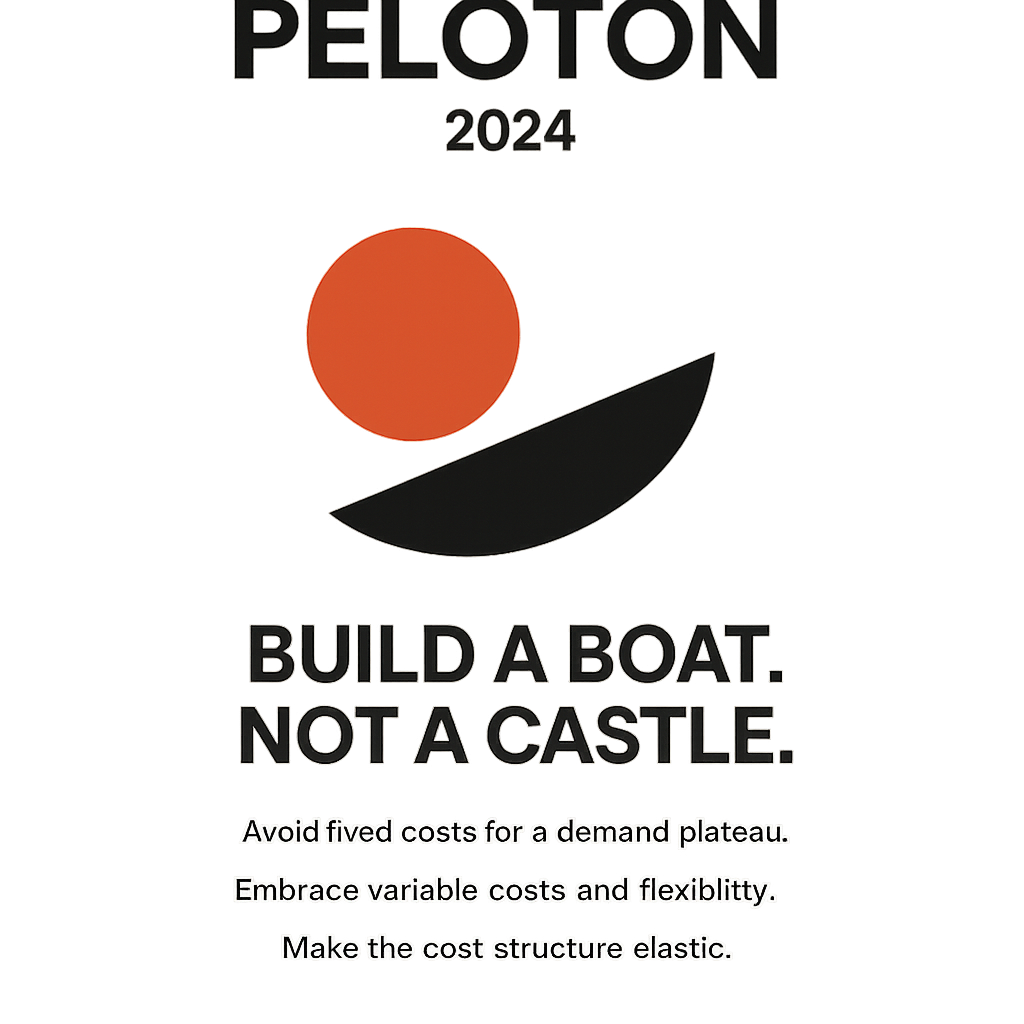
The business wasn’t broken. The cost structure was. Barry McCarthy said it plainly on an earnings call: the company had to “rightsize the spending of the business” to match the run rate, and cutting alone wouldn’t save them—they also had to grow revenue. (fool.com) That’s the constraint. Not “strategy.” Not “positioning.” Run rate. Reality. A company can survive a bad quarter. It cannot survive a permanent mismatch between what it spends and what the world will pay. Peloton had built fixed costs for a demand spike. It needed variable costs for a demand plateau. And you don’t get there with slogans. You get there with exits. The bold move wasn’t a new feature. It was subtraction. The kind that hurts because it touches identity. Peloton’s restructuring plan was not cosmetic. It was structural. It went after the bones: reduce headcount, close assembly and manufacturing plants, close and consolidate distribution facilities, and shift to third‑party logistics providers. (sec.gov) Read that again. Not “optimize.” Not “streamline.” Close. Shift. Reduce. Those are verbs with teeth. This is what focus looks like when you don’t have the luxury of romance. Peloton had to stop behaving like a company that wanted to own everything. It had to become a company that wanted to endure. The plan even included finishing and selling the shell of a facility tied to a previously planned “Output Park.” (sec.gov) A shell. That word lands like a metaphor. Because a shell is what you get when you start building a future…and the future doesn’t show up. So you walk away from the dream while it’s still concrete. And you sell the empty promise to pay for the next breath. This is the hard truth: scale seduces companies into building castles. Warehouses. Plants. Headcount. Internal logistics. Owned complexity. Castles feel safe. They look impressive in investor decks. But castles also become prisons when the world turns. Peloton’s constraint forced a different design philosophy. Less castle. More heartbeat. A membership business wants something simple: retention and margin. It wants recurring value. It wants to wake up each morning and know yesterday didn’t reset the company to zero. Hardware helps. But hardware is heavy. Hardware is lumpy revenue and volatile demand. Hardware is returns, recalls, shipping, inventory accounting, warehouse space, and forklifts. Subscriptions are lighter. They are closer to the customer’s life. They are closer to habit. But Peloton had built an operational engine as if it were primarily a hardware manufacturer at infinite volume. When the volume fell, the engine didn’t. So the move was to break the engine into pieces and only keep what served the core. The restructuring plan spelled out the mechanics with brutal clarity: workforce reductions, facility closures, consolidation, and outsourcing logistics. (sec.gov) Outsourcing is not sexy. It’s also not a failure. It’s a confession of what you actually are. And Peloton—at least in this moment—needed to confess. It needed to admit it could not afford the pride of owning everything. It needed to choose the customer over the empire. Now for the part most strategy articles avoid. The sacrifice. Sacrifice is the difference between a decision and a press release. Because you can’t claim focus until you’ve buried something you loved. Peloton didn’t just announce a plan. It paid for it. The filing describes charges tied to the restructuring—severance, exit costs, asset write‑downs, and other losses connected to the plan. (sec.gov) That’s the invoice. When you close plants, you don’t just flip a switch. You write down assets you once celebrated. You unwind leases you once signed with confidence. You tell teams they are no longer part of the story. You take the pain now so the company can exist later. There’s a particular kind of humility in shifting to third‑party logistics. It means you surrender control of a customer’s doorstep moment. You accept that your brand will now travel through someone else’s hands. Companies avoid that because they think control equals quality. Sometimes it does. Sometimes it’s just ego. Focus is not the same as control. Focus is deciding what must be perfect—and what simply must work. A bike must feel perfect. A class must feel alive. A delivery route must work. If you can’t afford to perfect all three at once, you choose. Peloton’s choice was implicit in the restructuring design: keep the customer experience and the membership engine central; make the rest elastic. Fixed costs kill you because they don’t forgive. Variable costs forgive because they move with you. They shrink when demand shrinks. They give you time. And time is the rarest resource in a turnaround. This is what made the move iconic—not because it was glamorous, but because it was honest. Peloton’s threat wasn’t that people stopped exercising. It was that people regained options. When the world reopened, Peloton no longer owned the context. So it had to earn the place it once inherited. That requires reinvention, yes. But reinvention without constraint becomes theater. Constraint forces the purest form of design: remove what you cannot defend. The filings say the company expected the restructuring plan to be substantially implemented by the end of fiscal year 2024. (sec.gov) That’s not a campaign. That’s a multi-year demolition and rebuild. And demolition is not weakness. It’s courage in reverse. Most leaders can build. Far fewer can unbuild. Unbuilding means admitting you were wrong at scale. It means trading growth narrative for operational truth. It means choosing the unphotogenic work: closing, consolidating, shifting, and shrinking—so the core can breathe. A timeless strategy emerges here, one that applies far beyond fitness, far beyond Peloton. When demand is a wave, do not pour concrete in its shape. Build a boat. A boat flexes. A boat can change direction. A boat doesn’t require you to predict the weather perfectly to survive it. Companies fail when they confuse a temporary spike for permanent permission. Permission to hire. Permission to build. Permission to expand into adjacent dreams. But markets do not grant permission. They rent it. And the rent comes due. Peloton’s restructuring was the moment it stopped paying for the fantasy and started paying for the truth. And truth, while painful, is stable. Truth is a platform you can build on. So if you’re looking for the Jobsian lesson—strip it down until it hurts—here it is: Your strategy is not what you say you will do. Your strategy is what you are willing to stop. Peloton stopped. It closed. It consolidated. It shifted to partners. It reduced headcount. It treated its own ambition as disposable in service of its customer’s habit. That is constraint-driven execution. And it’s the only execution that lasts. Because in the end, the market doesn’t reward the company with the biggest dreams. It rewards the company that can keep a promise tomorrow morning. One class. One ride. One breath at a time.