The Day a Company Refused to Be Owned
There’s a moment every honest company meets. It looks in the mirror and sees the thing it never wanted to become. A machine that must sell more, forev...
There’s a moment every honest company meets. It looks in the mirror and sees the thing it never wanted to become. A machine that must sell more, forever. Even if “more” burns the future. Even if “more” eats the soul. Most don’t survive that moment. They grow anyway. They call it success. They call it shareholder value. They call it inevitability. But a few choose the harder path. They choose constraint. They choose sacrifice. They choose to make the wrong move—by conventional rules—so the right thing can live.
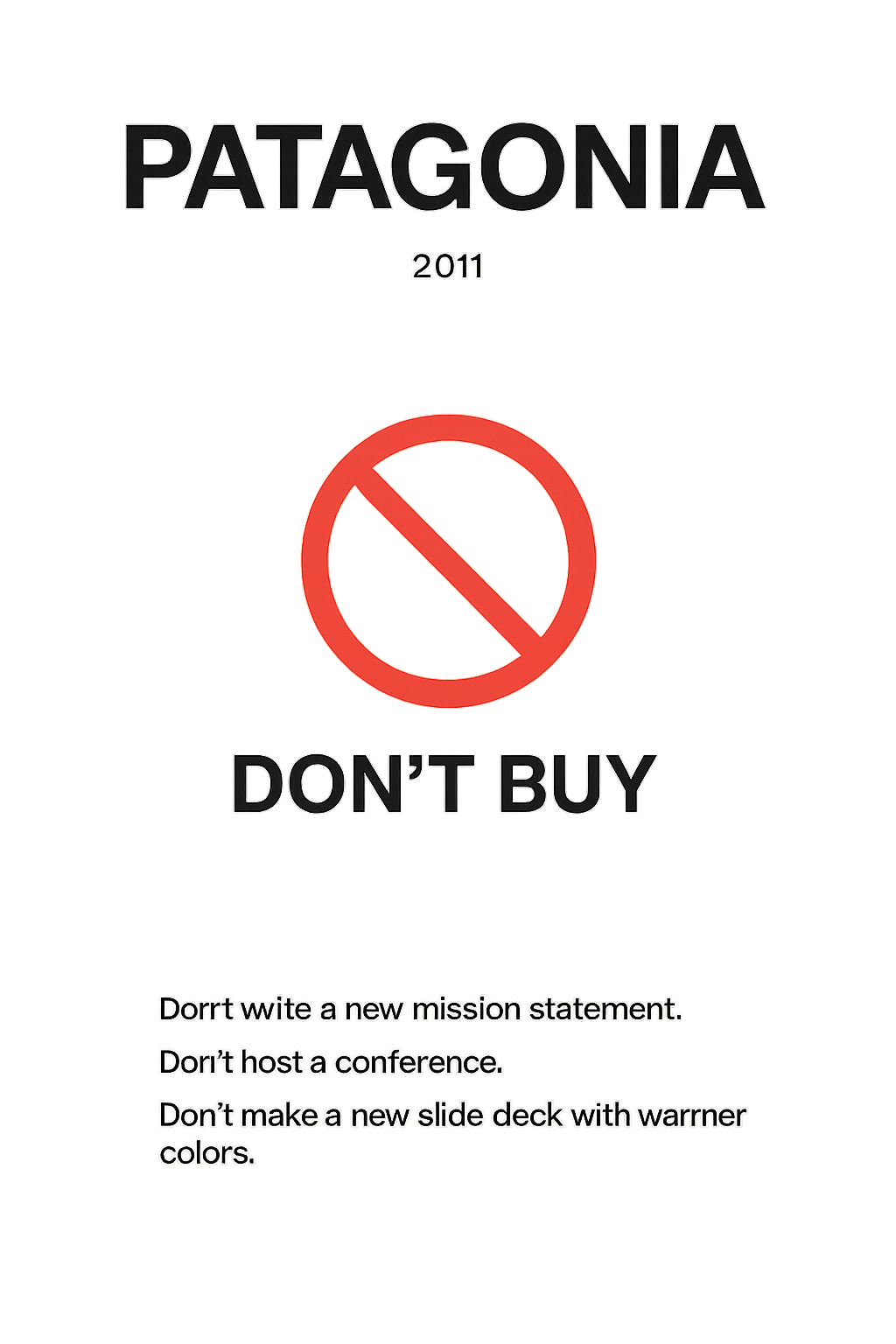
If your business model requires people to buy what they don’t need, your growth is a kind of theft. Patagonia faced the cleanest existential threat in modern commerce. Not a competitor. Not a recession. Not a new technology. A simple, brutal math problem: To grow as an apparel company, you must produce more apparel. To produce more apparel, you must extract more from the planet. And Patagonia’s own reporting and messaging had already admitted the uncomfortable truth: the planet cannot afford “more.” So what do you do when the core engine of your industry conflicts with the core purpose of your company? You don’t write a new mission statement. You don’t host a conference. You don’t make a new slide deck with warmer colors. You redesign the machine. You remove the incentive to drift. You make betrayal expensive. You make integrity the default. That’s the story. Not of marketing. Of architecture. Not of “brand purpose.” Of a decision that amputates a future you could have had. A decision that makes Wall Street impossible. A decision that makes “selling out” structurally hard. A decision that starts with two words no growth-obsessed executive can say out loud. Don’t buy. In 2011, the world gathered for its annual ritual. Black Friday. A holiday devoted to noise. The promise of happiness at 30% off. The idea that urgency is a virtue. Patagonia ran an ad with the opposite instruction: “Don’t Buy This Jacket.” (developmentaid.org) Not “buy ours because it’s greener.” Not “shop responsibly.” Not “we’re different.” A direct command. A refusal to play the game. And then the real point, the part most people miss: it wasn’t performance art. It was a constraint made visible. It pointed customers toward a pact—Common Threads—built around the 5 R’s: reduce, repair, reuse, recycle, reimagine. (patagoniaworks.com) That’s a dangerous promise for an apparel company. Because “reduce” is not a sales strategy. “Repair” is not a quarterly target. “Reuse” is not how you squeeze a consumer for lifetime value. It’s how you slow the machine. And slowing the machine is the one thing the market punishes—until it doesn’t. That 2011 moment matters because it reveals the core constraint with brutal clarity: Patagonia could not claim to fight for the planet while designing a company that must sell more jackets each year. You can’t put a greener sticker on a treadmill and call it progress. You either step off the treadmill. Or you admit you love it. Most companies choose the sticker. Patagonia chose the step. But here’s the uncomfortable part. A campaign can be copied. A slogan can be borrowed. Even courage can be cosplayed. The real threat was never a lack of boldness. The threat was time. Because even a values-led company drifts when the incentives drift. A founder retires. A CEO changes. A board evolves. A market tightens. A private company considers an IPO “just to fuel the mission.” And one day the mission becomes the story you tell while you do what everyone else does. That’s mission drift. It doesn’t arrive as betrayal. It arrives as pragmatism. And it kills more ideals than greed ever will. So Patagonia asked the only question that matters: How do we make drift harder than focus? How do we make the mission survive the people? How do we make constraint permanent? The answer was not a new product line. It was not an “ESG initiative.” It was ownership. On September 14, 2022, Patagonia announced its next chapter with a sentence that sounds like myth, and lands like law: Earth is now our only shareholder. (patagoniaworks.com) Not as poetry. As a structure. A redesign of power. The company transferred ownership into two entities: a purpose trust to hold voting control, and a climate-focused nonprofit (the Holdfast Collective) to receive the economic value that isn’t reinvested back into the business. (patagoniaworks.com) Read that again. They didn’t donate profits as a program. They donated the destination of profits as a system. They didn’t promise to stay principled. They made it hard to become unprincipled. This is where the story stops being about apparel and becomes universal. Because every industry has the same quiet temptation: Grow past your truth. Scale past your craft. Monetize past your dignity. Outsource the messy parts. Simplify the narrative. Complicate the pricing. Tell yourself you’ll “fix it later.” Patagonia didn’t fix it later. They fixed it at the root. They took the thing most companies protect above all—ownership—and used it as a lever to lock the mission in place. That is minimalist strategy. Not adding. Removing. Removing options until only the right ones remain. And yes, there was sacrifice. Real sacrifice. Not “we narrowed our focus to three strategic pillars.” The kind you feel in your stomach. They gave up the clean exit paths that make founders rich and companies fragile. No IPO roadshow. No auction to the highest bidder. No private equity “operational excellence.” No glossy acquisition that turns a culture into a spreadsheet. They chose a future where the company must keep earning, but cannot easily be sold to someone who will hollow it out. A future where profit exists, but its purpose is constrained. A future where success cannot be defined only by size. That’s what focus actually is. Focus is not intensity. Focus is not hustle. Focus is the courage to delete. And what they deleted was the most seductive feature of modern business: Optionality. Optionality makes you feel safe. Constraint makes you real. When you look at this through a design lens, it’s almost painfully elegant. The problem: Good intentions decay under bad incentives. The move: Change incentives at the level of control and cash. The result: The mission stops depending on mood. It starts depending on structure. Of course, structure alone doesn’t save you. You still have to execute. You still have to build products worth keeping. You still have to run a company that earns its way. You still have to make “repair” operational, not symbolic. You still have to do the hard, unsexy work of being consistent. Patagonia had been rehearsing that consistency for years. They framed anti-consumption not as guilt, but as a relationship. They normalized repair, reuse, and extending product life as part of the brand’s identity and operating model—an approach echoed in their own communications around the Common Threads framework. (patagoniaworks.com) And they embedded accountability into their corporate form earlier, too—becoming a Certified B Corp (2011) and a California benefit corporation (2012), explicitly describing those steps as ways to encode values into governance. (patagonia.com) These aren’t trophies. They’re constraints. They’re ways of saying: even if we want to cheat later, we will have to fight our own scaffolding. That’s the point. Great strategy doesn’t just pick a direction. It builds rails. Now, it’s tempting to turn this into a morality tale. Good company does good thing. Audience applauds. End scene. But the real lesson is sharper. Patagonia didn’t just choose “the planet” over “profit.” They chose a different definition of profit. They treated profit as fuel, not finish line. And they treated ownership as a design problem, not a reward. That’s why it feels timeless. Because the most timeless strategies don’t sound like strategies. They sound like a person finally telling the truth. Here is the truth Patagonia forced into the open: If you build a company that must grow without limit, it will eventually outgrow your values. Not because you are evil. Because the machine is hungry. So you have two choices. Feed it. Or redesign it. Redesigning it costs you things you can’t easily replace. It costs you applause from the old world. It costs you some kinds of scale. It costs you the easy money. It costs you the ability to say, “We had no choice.” Because after you redesign the machine, you do have a choice. And you have to live with it every day. That’s the hidden sacrifice: you can’t hide behind the system anymore. You are the system. So what can any company—anywhere—steal from this? Not the headline. Not the virtue. Not the aesthetic of conscience. The mechanism.
- Name the existential constraint in one sentence. Not a paragraph. Not a framework. A sentence you can’t dodge. For Patagonia, it was: growth in apparel can become growth in extraction.
- Make the bold move legible. If people need an explainer video, it’s not clear enough. “Don’t Buy This Jacket” is clear. (developmentaid.org) “Earth is now our only shareholder” is clear. (patagoniaworks.com)
- Prove focus with sacrifice. Don’t announce priorities. Delete something valuable. Delete a revenue stream. Delete an exit. Delete an audience that wants you to be everyone’s favorite.
- Lock it in with structure. Policies can be reversed. Leaders can be replaced. But governance—done right—becomes gravity. Patagonia made gravity point toward the mission. (patagoniaworks.com) And then the final, most human part. Constraint isn’t just a tool for business. It’s a tool for a life. Every person eventually faces the same choice Patagonia faced. Do you want to be admired by the market. Or do you want to be in alignment with your own words. Because the market will always ask for more. More speed. More output. More compromise. More spectacle. More you. And alignment will always ask for less. Less noise. Less appetite. Less performance. Less pretending. Patagonia’s move wasn’t perfect. No move is. But it was clean. It was readable. It was brave in the way that matters: not as a feeling, but as a design. A company looked at the direction of the world, and decided it would rather be constrained than celebrated. It would rather be limited than hollow. It would rather be owned by the thing that cannot speak—Earth—than by the thing that never stops talking—money. That’s not a campaign. That’s a choice. And choices, when made with clarity, become icons.